
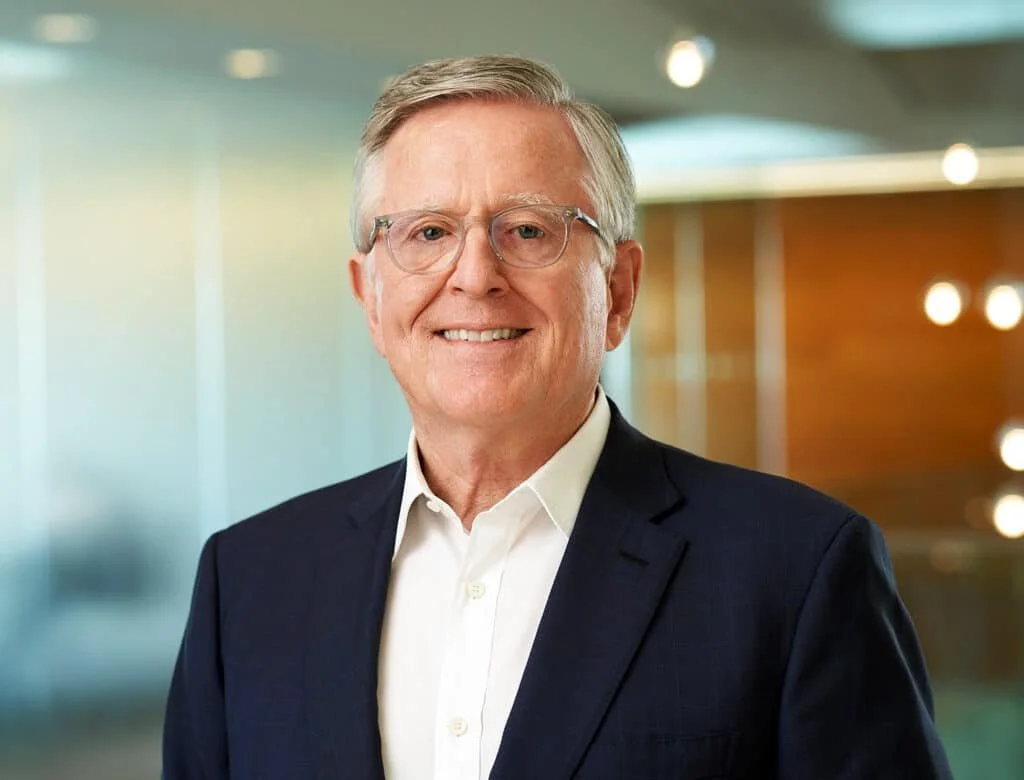
David Booth is Chairman of Dimensional Fund Advisors, a firm he founded in 1981. Under David’s leadership, Dimensional has grown from a fledgling business operating out of the spare room of his Brooklyn brownstone apartment to a global investment manager with more than 1,600 employees and $1.1 trillion (USD) in assets under management.
David led Dimensional as CEO and later Co-CEO until 2017, when he stepped back from the daily management of the firm. He remains closely involved in strategic initiatives at Dimensional. A trailblazer in the financial world, David helped create one of the world’s first index funds in the 1970s and launched the first passively managed small company strategy in the early ’80s. He has spent his career applying groundbreaking financial theory and research to the practical world of asset management, working closely with renowned academics to develop innovative investment strategies that he believed could outperform index funds, pioneering what would later be called factor investing.
David received a bachelor’s degree in economics in 1968 and a master’s degree in business in 1969 from the University of Kansas. In 1971, he received an MBA from the University of Chicago. Over the years, David has been a benefactor to both schools. Upon announcing a gift from the Booth family to the business school at Chicago in 2008, David cited his education there as being instrumental to his later success with Dimensional. The University of Chicago Booth School of Business is named in David’s honor, and the gift has helped to advance its field-defining research and to support the school’s faculty, a number of whom have had close ties to Dimensional. David has also donated to support athletics at the University of Kansas—as a boy, he ushered there at football games—and he is a vocal advocate of the role sports play in keeping alumni connected to a school.
An avid art collector and enthusiast, David has participated in and donated to artistic initiatives across the US, and the David Booth Conservation Center and Department is responsible for the preservation of the Museum of Modern Art’s collection in New York.
In this episode, we welcome back David Booth, Co-Founder of Dimensional Fund Advisors and author of Stay Calm: Learn to Embrace Uncertainty in Investing and Life. David reflects on his remarkable career at the center of the evidence-based investing revolution, from studying under Eugene Fama at the University of Chicago to helping build investment strategies around decades of financial research.
We explore what the data revealed about markets and professional money management, why implementation matters as much as great ideas, and how investors can make better decisions without trying to predict the unpredictable. David also shares his views on trust, financial advice, public versus private markets, human ingenuity, and the meaning of true wealth. Along the way, he explains why staying calm, having a process, and staying invested can matter far more than finding the next winning forecast.
Key Points From This Episode:
(0:00:04) Introducing David Booth and his new book, Stay Calm: Learn to Embrace Uncertainty in Investing and Life.
(0:01:15) What David learned as a commission-based shoe salesman: Do the right thing and be upfront with people.
(0:03:35) The gift of being an outsider and how financial science changed the investing experience for ordinary investors.
(0:05:38) Why outsiders are often willing to challenge assumptions—and how data changed the debate.
(0:06:53) David's experience arriving at the University of Chicago and studying under Eugene Fama.
(0:07:49) Inside Chicago's rigorous research culture and the lessons David learned from presenting his work.
(0:10:03) The empirical challenge behind efficient markets and why data mattered more than beliefs.
(0:11:41) How Fama and French approach research by trying to prove their own conclusions wrong.
(0:12:05) The two-fish joke and the challenge of understanding the environment we are immersed in.
(0:12:45) How Jim Lorie and Lawrence Fisher helped provide the historical market data that transformed financial research.
(0:14:18) From early mutual fund research to the question that shaped David's career: What should investors do if managers cannot consistently outguess the market?
(0:20:59) Why Dimensional distinguishes between passive investing and indexing.
(0:23:21) The origins of Dimensional's approach to small-cap investing and the importance of execution.
(0:24:45) Why David would rather be an investor today than in 1971.
(0:26:21) Jensen's alpha, risk-adjusted returns, and what Michael Jensen's research revealed about professional money managers.
(0:28:30) Why implementation is everything—and why models are tools for making decisions under uncertainty.
(0:33:47) Why the most important thing about an investment philosophy is having one you can stick with.
(0:35:46) Why David sees education as an antidote to fear and wants investors to feel more optimistic about investing.
(0:36:18) Human ingenuity as the foundation of David's optimism about markets.
(0:37:53) Why trust is the ultimate product in the investment business.
(0:39:40) Why understanding the science alone is not enough—and how advisors can help investors stay invested.
(0:40:23) What David's art collection has taught him about non-monetary returns and true worth.
(0:43:07) Why a good financial plan is a process built around trade-offs, flexibility, and adaptation.
(0:45:22) The problem with fixed goals and why David thinks many goals are inherently fuzzy.
(0:46:34) How David distinguishes between forecasts, wishes, and worries.
(0:49:44) How investors can identify and tune out noise by focusing on how markets work over the long term.
(0:51:30) David's unfiltered perspective on private markets, transparency, price discovery, and liquidity.
(0:52:38) Why true wealth begins with values, family, and the things that matter beyond money.
(0:54:57) What winning means when wealth includes both monetary and non-monetary rewards.
(0:55:39) Why David describes optimism as science-based hope.
(0:57:33) What Stay Calm means to David: Make decisions aligned with your values, build a process, and trust that you can deal with whatever comes your way.
Read The Transcript:
Ben Felix: Welcome to episode 424 of the Rational Reminder Podcast. I'm Ben Felix, Chief Investment Officer at PWL Capital.
Cameron Passmore: And I'm Cameron Passmore, Chief Executive Officer at PWL Capital.
Ben Felix: Today we're joined by David Booth, who co-founded Dimensional Fund Advisors in 1981 in the spare room of his Brooklyn apartment. And today that firm manages roughly $1 trillion in global assets.
Cameron Passmore: And today we discuss his new book, Stay Calm: Learn to Embrace Uncertainty in Investing and Life. And we dive into insights from his 50 plus years at the center of this evidence-based investment world.
Ben Felix: Make sure you stick around to the end to hear Cameron and my thoughts on the conversation. But for now, let's get into the episode.
Cameron Passmore: David Booth, it's a great pleasure to welcome you back to the Rational Reminder Podcast.
David Booth: Well, it's great to be here again. Thanks for having me.
Cameron Passmore: And congratulations on your fabulous just released book. I read it twice and I think it's a terrific piece of work and a terrific representation of your career, quite honestly.
David Booth: Oh, thanks. That was tough writing, but we slugged our way through it and I'm pleased with what came out.
Cameron Passmore: No kidding. So I have to ask you, what lesson did your job, I believe it was Aaronsburg Shoe Store. So what lesson did that teach you?
David Booth: Well, I was a shoe salesman in my senior year in high school and then in college. It was a commission based system, heavy commission. It was a great learning experience because what I learned was, even though I had a huge incentive to make a sale, even more important than that was when I went home at night, I wanted to feel good about myself.
I realized I really wasn't into selling people shoes that didn't fit or try to browbeat them into buying something they really didn't want. The client would be happier and I'd be a whole lot happier if we just found a good outcome. And sometimes you just don't have the right shoe with the right size and that's okay too.
Ben Felix: I love the story. I have to ask, was there a shoe sale that you regretted?
David Booth: Yeah, early on. I mean, I came to this conclusion after I made the mistakes that people selling on commissions make. I mean, I sold people some shoes and I felt really bad about it. So I go, I'm not going to do that again.
Ben Felix: Super interesting. That lesson and that thinking, how did you apply that to the philosophy that underpins Dimensional?
David Booth: Has nothing to do with the investment philosophy, but has everything to do with a business philosophy. Do the right thing. And sometimes you don't have the right shoe or whatever. You're not what people are looking for. And that's fine too. Just be upfront with people.
And over the long haul, maybe you have a good scientific basis for what you're doing and you have a good argument, then you'll be fine. You won't convince everybody. That's okay too.
Ben Felix: You mentioned that it has nothing to do with the investment philosophy. I don't know if I agree with that. I think it has a lot to do with the investment.
But when I found Dimensional, I was disillusioned with the investment management industry, preparing to leave the industry entirely. And I found Dimensional's products and I was like, wow, that's a type of investment that works with science-based thinking. That makes sense to me.
I don't know if you can disconnect that way of thinking about what is right from the investment philosophy.
David Booth: Even as a lowly shoe salesman, I knew that some shoes were made better than others. And as long as I was upfront with it, sometimes a lower cost shoe is really the more expensive one.
Cameron Passmore: That's a great line. What is the gift of being an outsider?
David Booth: This kind of came up when we were writing the book. My parents were great people. I grew up in the great depression and fought in World War II.
And I had a different experience, set of life experiences than we all have had. They never really invested in publicly traded stocks and bonds. They thought of themselves as outsiders and that insiders made all the money.
If they invested, the insiders would just take advantage of them and they wouldn't have anything. They never invested. And that's where the science comes in.
If you look at the science that was developed in finance in the 60s and 70s, you can summarize it with two points. The first point is, if you look at stock and bond markets, their returns behave the way we hoped they would. They're ups and downs for sure.
But over the long haul, stocks have higher returns than bonds because they're riskier and bonds keep pace with inflation. If you look at stocks over, we have a hundred years of data now. That starts with the great depression or before the great depression, even helped through World War I, the great recession, COVID, all these periods of time where people have tremendous anxiety.
I mean, people have a lot of anxiety today, but I don't think it's probably any higher than it was in a lot of these times in the past. And throughout all of that, stocks have done about 10% a year. So that's kind of point number one.
Stock returns behave like we hoped they would, and they give a fair return, about 10% a year. That seems perfectly reasonable. Second point was, professional money managers trying to outguess the market don't seem to be able to do that.
Once fees are considered, they do worse than the market. So those are two points that my parents didn't know about that should make them feel okay to be an outsider. You'll do as well as the insiders.
That's pretty uplifting messages. In other words, investing in public markets is for everybody. It's not just for a few.
Ben Felix: What do you think are the unexpected benefits or lessons of that outsider mindset?
David Booth: Well, I think you're willing to challenge the assumption. You can carry the outsider argument even further. If you look at the academics that brought on all this change, they were outsiders.
They were coming up with conclusions that Wall Street hated. The big breakthrough, of course, was that they had data. That's what changed everything.
Before 1960, there really wasn't research-quality data that you could test very many hypotheses. And that all changed as the data became available, and computers got big enough to process all this data. This was big data back before people even called it big data.
You know, armed with that, then all of a sudden, it was hard to refute the arguments. These are what the data show. This is it.
You can argue that you don't like the data, but this is the data. As this revolution was unfolding and we were starting to talk to average investors about it and stuff, a lot of times people just stared at you, you know, like, okay, you showed me the data. Professional money managers don't seem to be able to beat the market, but I can't believe that.
Okay, well, you can't believe it. I believe it, and I have data. You don't believe it, and you don't have data. Once you get some data, come back to me.
Ben Felix: Can you talk about how much of an outsider you felt like in the early days when you were challenging these ideas on Wall Street?
David Booth: What happened to me was I got accepted to a PhD program at the University of Chicago. One day, I'm in Kansas. The next day, I'm in Gene Fama's class studying all this stuff, surrounded by all these professors, several of whom went on to get Nobel prizes and so forth.
It was all incredibly stimulating. I was so much of an outsider, I didn't even feel like an outsider. I mean, that's how much of an outsider I was. All this language. My parents never had money to invest. It was all brand new to me.
I knew I was an outsider. Also, though, my first class, you know, with Eugene Fama, turned out to be my mentor. He explained how markets work and was also sensible.
He'd go, that must be the way it works. It wasn't until later that I realized that Wall Street and other people had a different point of view.
Cameron Passmore: You have to expand on that experience, David, because I've heard you tell the story a few times. How mind-blowing was that first class with Professor Fama?
David Booth: Well, it was mind-blowing. Then, pretty soon, I'm in working on empirical papers. What they would do at the business school, the finance department would meet weekly if anybody wanted to show up.
Professors and PhD students would sit around a table and they would go over each other's research that they were working on. These are not finished papers. Well, sometimes, it was finished papers, but it didn't have to be.
It was collegial in the good sense of the word in those days. People looking at research results and say, well, maybe, what if you tried it this way instead of that way? For one thing, it sharpened your research skills for sure.
There's some Pyrrhic victories in there on research. You know, I remember standing up there first time or two presenting a paper to people like Gene Fama and Merton Miller and Myron Scholes or whatever. Of course, they had a lot of, let's call it constructive feedback on ways I could improve.
I'm standing there thinking, you know, don't they give a first-year student any slack? Of course, the answer is no. If you've got the chops to stand up there, then you need to take whatever comes your way.
Valuable lesson. That's why I said it's a Pyrrhic victory. Sometimes, I could get a paper across, but it would come at a huge cost.
First off, none of these guys had Nobel Prizes at that time, but we're sitting on such powerful data. These results are mind-blowing, and nobody's trying to apply the ideas. So what happened to me was, and I remember vividly going back to Christmas, my second year in the program, to my grandparents' house in a small town in southeast Kansas.
They didn't have indoor plumbing or central heating. It was an outhouse and coal stove. And we had all my aunts and uncles and cousins there eating Christmas dinner, and they're all laughing and shouting and having a great time.
And I was totally stressed out. I go, what's wrong with this picture? I'm presumably the top of my game here, and I'm not feeling good.
And that's when I realized for the first time, hit me what really true wealth is about. I mean, these people were wealthy. They just didn't have any money, but they had their family, and it was all about family for them.
Ben Felix: With respect to efficient markets, what was the nut to crack?
David Booth: Well, the nut to crack is empirical work. People torture the data. Statisticians, there's a saying, if you torture the data enough, you can get it to confess to anything.
So they would be torturing the data, trying to find ways of beating the market and just coming up shooting blanks. And pretty soon, I think it was Fama kind of put it all together. He said, look, it doesn't look like these people are adding any value.
Maybe markets are efficient. How about that? The market does such a good job of setting prices that professional investors even don't seem to be able to do better than that.
That's a breakthrough. Number one, intellectually, it's incredibly gratifying. And also at the same time, socially, it's the desired outcome.
It would be awful if certain small groups of investors systematically ripped off other groups of investors. That'd be kind of awful. Most people without looking at the data, that's kind of what they feel. I'm going to get ripped off. We had the data. So we keep coming back to the data.
I learned from Fama and Miller, you can make any argument you want. And if you don't have any data, you're just arguing beliefs, which is fine. You need to have beliefs.
I tell people, here's some things I believe. But in a debate, you want to have data.
Ben Felix: Reminds me of – we had Cliff Asness on the podcast a while ago. He's another one of Fama's students. He talked about his research on momentum, if I remember correctly.
Fama's comment to Cliff was, if it's in the data, you have to publish. Cliff was worried about publishing something about momentum that seemed anti-efficient markets. Just an interesting anecdote about Fama.
David Booth: That's Fama for sure. In fact, what Fama and French do, Ken French being his longtime colleague, is once they get the results they think are persuasive, then they go back and try to prove that they're wrong. By the time they sign off on a paper, you don't have to worry if there's a typo in there or they didn't run the test properly. They're amazing.
Cameron Passmore: In your book, David, there's a joke about two fish. What can that joke teach us about the history of the stock market?
David Booth: Two fish are swimming along in a pond or whatever and one of them says, hey, what about this water, huh? The other one says, what's water? I think this empirical research and all the science is trying to figure out what pond are you fishing in?
What is the world around you that you don't really understand fully yet? That was a tough question, by the way. I've been thinking about that one, how I would respond to that. That's good.
Ben Felix: Good joke. What did the work of Jim Lorie and Lawrence Fisher teach us about markets?
David Booth: Well, they provided the data. Jim Lorie was one of my favorite people. He was one of these professors.
He was never going to get a Nobel Prize and I don't think he bought into this notion of market efficiency or whatever. He was old school, very urbane, dapper, very clever guy. He was on the board of Merrill Lynch and he persuaded Merrill Lynch to fund the data collection on stock returns and bond returns, starting as far back as he and Fisher could go was 1926.
I asked Larry once, why did you stop there? He goes, well, the data just couldn't, I was pulling my hair out. I couldn't go back any further.
It was too bad, too awful. Lorie sells Merrill Lynch on the idea and Larry Fisher did all the work. That's what I mean.
In fact, the end of my first year, I was talking to Jim about maybe working for him the next fall. He says, go talk to Fisher. So I go talk to Larry Fisher and over the next half hour, we have this one-sided conversation.
He's talking about something. I have no idea what he's talking about. So I go, I think I'm better off working for Gene Fama.
When I came back the second year, I worked for Gene. So those people set it up and Larry Fisher, he did some good research as well. Lorie also brought in, well, he was an assistant, he brought in, recruited Merton Miller and Merton Miller was really Gene Fama's mentor.
And so in some ways, Lorie had a huge impact on the University of Chicago.
Ben Felix: What do you think their work revealed about the broker-customer relationship?
David Booth: They didn't really get into that because they didn't really study transaction costs. They didn't study individual behavior. Back in the early sixties, people could sometimes get PhDs just by producing tables of data.
This was a very primitive era. When the data started coming out here, Lorie says to Fama, who was a PhD student, hey, we've got this data coming. I want you to use it.
Fama was among the first to use the data. And he then started looking at the behavior of stock prices. And Michael Jensen comes along and does the first big study on mutual fund performance, showing the dismal character of professionally managed portfolios that are trying to beat the market.
I have to add all that, by the way, because we're a professional money manager and we try to beat the market. We just don't try to do it by outguessing the market. We use our understanding of the science in order to help us form portfolios.
And then we've developed a skill over the years of dealing with what you can call market mechanisms, trading costs, securities lending, any number of little details in the trading process. Every step along the way, you can add just a little bit of value here and there. Anyway, that's going back to the early work.
People start asking the question, well, if these professional money managers can't do better than market, what are you supposed to do? I've spent the last whatever, 57 years working on that problem, learning from others.
I mean, that's the big question. It ties into the big developments in finance and investing in the 20th century and now the 21st, which is a move towards passive funds management and indexing. And I think it's important to separate the two.
So you have this data coming out of Chicago, MIT, and Stanford, whatever, but it's a relatively small group of researchers changing the world. And they have for the better. Based on their work observed over the last 50 years or so, management fees have come way down, investment choices have gotten much better, and that's all due to this data.
So eventually, I decided I didn't want to be a professor. Actually, it turns out I'd done a term paper for Milton Friedman, and he was kind of lukewarm on it. And I go, man, I'm killing myself.
Because Milton had a view that the changes in money supply caused everything in the whole world to change. I'd go, yeah, but Milton, suppose you could predict changes in the money supply. Even though money supply causes stock prices to change, stock prices might even change before money supply changes.
He wasn't buying that at all. So that was kind of the thrust of our paper I did with Roger Ibbotson, because the business school professors liked the paper. I read it recently.
It was pretty good. Milton, I go, oh, man, I'm not cut out for this. So I walked in the office the next day to Fama's office, and I said, I'm going to leave the program.
He said, okay, well, I've had this guy out in San Francisco, Mac McQuown, and he's always wanted one of my students, so I'll give him a call. So Gene gives Mac a call, and Mac calls me up, and we kind of hit it off over the phone. He comes out and has dinner with me and then invites me to join him at Wells Fargo, which I did in September of 71, just as they're getting ready to launch what you can consider to be the first index portfolio for the Samsonite account.
It's known in the literature as the Samsonite account, because Samsonite funded with $6 million a portfolio strategy. This strategy was developed by Fisher Black and Myron Scholes. When I went to work at Wells Fargo, the consultants we used were Fisher Black and Myron Scholes primarily for my group.
And along the way, while they're working together on our project, they developed the Black-Scholes option pricing model, which is one of the biggest changes in finance ever. Fisher and Myron had said, well, if you can't beat the market, what we can do is create a portfolio that has a higher beta than the market. The market has a beta of one.
If you have kind of equally weighted amounts in each security, your beta, they thought, would come up around 1.15. That had a chance of beating the market. I don't want to go into the merits of this. It wasn't silly in the sense that in a business school setting, you know, yeah, okay, well, that theoretically makes sense.
It's silly in the sense, practically, that was never going to fly. They were the first and the last client for that strategy. But it sent a signal that even if professional money managers can't beat the market by out-guessing it, there are ways you can beat the market.
Eventually, this way of thinking led to the creation of Dimensional. And you observe our first strategy was a small-cap portfolio. We call it micro-cap now.
The logic was pretty straightforward. We went into the biggest pension funds in the world, sovereign wealth funds, and said, look, if you're forming an equity portfolio, you ought to have stocks of large companies and small. You shouldn't have all your money just in large.
And in 45 years, everybody's nodded agreement on that. And said, well, that's what we'll do. We'll give you access to the small companies.
We think that they have a higher expected return. Of course, the first nine years, they didn't. They underperformed significantly.
But the last 35 have been great. But that's what you're supposed to do. That's the way of using the science.
And in addition, along the way, we had to develop, we had to kind of add to the science by the way we execute trades. That was kind of absent in the literature. So we were the pioneers in developing a way of trading for people that are so-called passive.
Okay, so that was one part of Wells Fargo. The other part was the trust department. I don't know, there must have been some marketing genius come along and they go, well, you know, what you really want to do, since managers can't beat the market, is you want to do an S&P 500 index fund.
They go, okay. And the reason I say marketing genius, because that is easy to sell. I'm going to sell you.
All you have to evaluate is, does my portfolio track the index or not? And it's pretty easy to do that. That idea took off slowly, but eventually took off and Wells Fargo sells it to BGI.
Now it's the cornerstone for BlackRock. Their high shares and all of that comes from this trust department at Wells. That's great.
And as I tell people, no scientist would come up with that conclusion. That's why I call it a marketing idea. And the reason a scientist wouldn't come up with it is an index fund puts a constraint on itself.
I want to track the performance of an index. Constraints come at an economic cost. Already, I mean, I'm turning this fun conversation into something a little too technical, but....
Ben Felix: No, no, this is perfect.
David Booth: We never went down that path. Yeah, indexing is okay, but there have to be better ways to invest. The example we often use is Standard & Poor's.
The index is a managed portfolio. They decide which stocks go in, which ones go out. It's arbitrary.
The S&P 500 is 500 of the largest companies in the country, but not the 500 largest. They have their way of characterizing the market. And then they decide, if they're down to 499 names, they pick a stock to go and be the 500th.
So that's, in some sense, stock picking already. Well, if you're an index fund manager, and let's suppose they add a stock today, they're going to add that stock in at tonight's closing price. That's the way index providers, that's the way they create an index.
So if you are an index fund manager, then you want to buy the stock at tonight's closing price. Well, I don't know if you've ever gone to a broker and say, can you sell me this stock at tonight's closing price? At some commission, if you say, I want you to guarantee me the closing price, you can get it done, believe me.
And that's what an index fund has to do, is buy it at tonight's closing price. So you'll be going around, if you're an index fund manager, waving your arms and go, I will pay anything, but I've got to have tonight's closing price. At the same time, all the other S&P 500 managers hover around waving their arms, saying, I've got to have it tonight's closing price.
Most recent evidence we've come up with is, on average, that pushes up price of that stock 4% beyond what a fair price is. When I was in Wall Street, you would have guys playing this three-card monte. You'd have three cards, they'd flip the cards around.
You'd have to guess where the ace is. And you could, of course, never get it done right. And that's what's going on here.
People are fooled that they're not paying a trading cost, because they're buying at tonight's closing price. But that price is 4% too high. And tomorrow, when trades happen, it changes back.
You ask a simple question, I think, about starting off with the idea of passive management. So we're proud to say we're passive and not indexed. And indexing is not bad. It's not great.
Ben Felix: Did you think about all of that stuff as deeply as you just described it when you launched Dimensional?
David Booth: Yeah, because I had this experience as well as 10 years earlier. Rex Sinquefield, who was one of the founders along with me, two of the names we mentioned helped start the firm as well. Gene Fama and Mac McQuown became founders of the firm as well, which has been part of the joy of my career.
Rex had run index funds at the bank he'd worked at. And we said, OK, we're going to deal with small cap stocks. These stocks are very thinly traded.
Any kind of significant size order is going to move the prices around a lot against you. Let's not trade like index funds. Let's trade throughout the day.
I think hopefully I've given you the argument as to why you'd want to do that. The downside of that is people go, well, look, you don't know anything about the stocks you're buying. Why aren't you just going to get bagged?
If you look at pure capitalism, you know, the trading floor is about a pure capitalist system. Traders try to pick off neophytes the best they can. Lions eat zebras for a living.
That's what they do. We go, well, we don't know. We decided we were going to develop a skill set in actually trading and implementing, which is what we did.
But because there was so much uncertainty, people gave us small amounts of money to get started off with. We had to earn the trust. Or as Myron Scholes said, ideas are cheap.
It's execution that counts. We had to develop a skill in execution that once we were able to do that, then we were pretty well set.
Cameron Passmore: You joined Wells Fargo 55 years ago. If you're an investor listening to this podcast, would you rather be an investor starting out back in 71 or today?
David Booth: Today, by a wide margin. It isn't even close.
Cameron Passmore: Really?
David Booth: Well, if you do an as of trade, if you give me the stock prices as of 1971, yeah, I'll take that. But going back, no, I mean, management fees, they were unconscionably high. One or two percent a year, management fees, trading costs.
Believe it or not, people forget the SEC allowed the New York Stock Exchange to set commission rates on trades. And the commission rates the New York Stock Exchange set were unbelievably high. Probably order of magnitude, maybe 10 times or more, 20 times higher than the commissions we pay today, which that then led to the creation of this soft dollar industry because you had to pay so...
And institutions had to pay those as well as individuals. So institutional investors would say, okay, well, I'll do trading with you, but you have to give me research or something else. It's kind of like frequent flyer miles.
If you pay full price for your ticket, they would give you triple frequent flyer miles or something. So that was the industry. Custodian costs were much higher.
You still had some banks doing handwritten ledgers. I know it sounds like I was on the boat with Noah, but this was a different time period.
Ben Felix: You mentioned Michael Jensen's work, why that was important and what it contributed. Can you talk a little bit about Jensen's alpha and why that measure became so important to all of the things that we're talking about?
David Booth: Starting in the 60s, researchers had data. And with data, they could test out hypotheses. And models, test out models.
Once you have that, then you really have a science. Without data and testable hypotheses, you don't really have a science. So we have the science.
The risk return model that all the academics used back in the 60s was the capital asset pricing model. What that model said was the risk of a portfolio is its beta, which is a relative fluctuation. The market has a beta of 1.
If you have a portfolio or stock with greater relative fluctuations, beta will be greater than 1. If it's fluctuated on balance, it's less than the market, beta will be less than 1. What you would want to do then is calculate your return versus your risk-adjusted return, your beta-adjusted return.
You can forget about beta. The central point is all these models testing risk and return are models. And if you look at the average return of a stock or a portfolio, and you subtract out what the model said that return should be, the difference between the two is an alpha.
They called it the Jensen alpha because he was the first one to use it on portfolios. In a nutshell then, what Jensen's research showed was professional money managers had negative alphas, negative Jensen. Once you adjust it for beta, they underperformed.
Ben Felix: It's crazy to think, and I know I'm spoiled by having grown up when all this stuff had already been figured out, but it's crazy to think back to a world where we didn't have the ability to do that type of analysis. You're just guessing and hoping.
David Booth: You're just guessing and hoping. The obvious problem with that is people can claim anything and fees and stuff were so high, it's going back to like selling shoes. I mean, the commissions, if you could make a sale, you could make a lot of money. The people with the best sales pitches won.
Cameron Passmore: I think a lot of listeners are in a similar position to me from when the first time I met you 24 years ago, where you kind of get the ideas, but you don't really appreciate the implementation. Can you talk about how important implementation is to great ideas?
David Booth: Particularly now, the financial science is pretty much in the public domain, particularly Farma and French. They insist their research be in the public domain. A number of our competitors don't feel that way.
They come in and they go, well, I've just developed this new research and look at this. You don't know if they've done the work right or not. They haven't vetted with anybody else.
Being so many years in the business, I find it hard to believe that anybody's going to come up with a brand new research result that's earth shattering. You've had thousands of professors over 60 years and who knows how many grad students and other researchers pouring over the same set of data. There may be some sprinkling of gold dust somewhere, but I don't think you'll find huge nuggets.
The implementation, as Myron said, it's everything. You go to the marketplace. If you buy stocks and you always pay the offer side of the market and when you sell them, you always get the bid side of the market.
Over the long haul, that adds up, even if you don't trade very much. Ken French, I think, thinks of execution more, not only the trade, but execution being the engineering, the forming of the portfolio. For example, you look at all the index providers.
A lot of them have various forms of a market index. They all do it differently. There's no right or wrong way.
But when we come out with an investment approach, the first thing we do is figure out what are the parameters for forming the portfolio. Having people like Fama and French, who they were the ones that developed the multifactor story, the empirical model for it anyway. It's great having them on the team.
Models don't explain everything. If they did, as Fama says, you wouldn't call them models. You'd call them reality.
Or as Bob Merton, Bob's another Nobel laureate, is our resident scientist. He says, you know, models are inherently incomplete. This is something I want to pursue this year, which is, I think models are off-putting to people.
When you say model, people go, I don't know about that. The way to think about models is what you use to make a decision dealing with uncertainty. You have data in front of you and you have to make a decision.
What goes through your mind to come up with that decision? That's a model. You're not going to be right every time.
That's why they call it uncertainty. If you're right all the time, you'd be in the world of certainty, which is okay, except all the interesting decisions in life have to deal with uncertainty. Now we're getting into my passion as well, which is, I'm back at Chicago and I'm studying econometrics and learned how to make big models of the economy and all of that, which I think are of questionable value.
And then about 10 years ago, I realized, human beings, going through life, you have to make decisions under uncertainty. Life is incredibly complex. You know, you have all these factors interrelate to each other.
You have to make a decision. You have incomplete information and you may make a decision that affects you over here, but it hurts you over there. And somehow you arrive at all those things.
Just growing up, if you think back on it, you've learned how to deal with uncertainty. So it ought to put you in a pretty good position for talking about investing. Sometimes tell people, look, you know more about investing than you think you know, because you've learned how to deal with uncertainty in life.
So let's trace through how you did that without getting into the nitty gritty. Everybody's probably got a story about a big decision they had to make. I did this once for Thanksgiving with my kids and their plus ones.
Now they're spouses. Tell me a story about a big decision you had to make and tell me the outcome. Pick a story that worked out well.
I don't want to hear sad stories. They come back with these stories and every one of them you could trace through. Okay.
Yeah. You had the information you had. You focused on number one, you developed a plan.
You didn't try to predict what would happen because you're no use trying to predict the unpredictable. So you started with a plan. You played for the long haul, controlled what you could control, try to minimize the rest, then step back, play for the long haul and get the benefit of compounding. That's investment theory. You can't predict markets. You can control how much risk.
So to come up with a plan, say largely how much you have in relatively risky assets versus relatively riskless. Come up with the right plan that's right for you, may not be right for your neighbor down the street, but figure out something you can live with because staying invested is one of the keys to success as well. Then pay attention to what's going on.
Make changes from time to time, but don't make changes based on short-term forecasts of the market. Make changes when you're going through your life, you're probably going to have, I don't know, six or eight or 10 times where your life changes so much you may want to rethink your investment approach. Other than that, come up with something sensible and step back and realize, you know, I've done everything I can.
Sometimes the results will be disappointing. You should never criticize yourself then because you made the right decision. Like in sports, sometimes you make the right decision.
It just doesn't work out.
Cameron Passmore: That's right.
Ben Felix: I got to say that Thanksgiving story, I would expect no less in the Booth household for a Thanksgiving activity.
David Booth: Here you go. Yeah, right. Oh, dad, you know.
Ben Felix: That was all awesome. It reminds me of your quote. Hopefully I get it right.
"The most important thing about an investment philosophy is you have one that you can stick with," which is such a good quote.
David Booth: If I ever do a second book, it'll be called Stay Invested. That'd be kind of cool. First book, Stay Calm.
Second one, stay invested. But going through the process I just outlined, you can see how if people go through that in their personal lives, they're more likely to be able to stay calm. Same way with investing.
I point out, investing is complex. So most people, it sounded simple, but most people benefit substantially by going to an investment financial advisor. Just like when they have a serious medical issue, they go to a doctor.
Yet some people try to solve their own. Everybody's got a big financial problem. Even people with the most money, they have a succession plan.
Everybody's got financial issues they need to work on. Everybody I know, and I know some pretty bright people, they all use financial advisors. That's part of the story as well in the book.
Part of the goal of this is try to get people to invest. A lot of people just never start investing. Those are the people I'm really trying to reach.
And the reason they don't sometimes is they feel awkward calling up or interviewing a financial advisor. They don't know what to say. The last chapter of the book is, here's some questions.
If you go talk to an advisor, here's some questions you might want to ask. Also, by the way, here's some questions they're likely to ask you. I think that will make people more likely to go find an advisor.
Ben Felix: A lot of what you're just talking about made me think of a quote from a different past podcast guest we've had, Chris Hadfield, who's a Canadian astronaut. He said that "competence is the antidote to fear." I think a lot of investors are scared because they don't understand the stock market.
Like you mentioned it earlier, they feel like they're going to get ripped off. But there's a certain level of education and information that I think can make people very comfortable with investing.
David Booth: I wouldn't argue against that. I might, instead of competence, go education. Education is the antidote to fear.
Because if people understood better how markets work, they'd be more likely to invest. Really, the motivation for writing the book, I want people to feel more optimistic about investing and feel more confident that they're going to have a good investment experience.
Ben Felix: On that note, can you talk about how humans' desire to improve helps to explain financial markets?
David Booth: It's the cornerstone of everything. Once you explain to people that stocks have a 10% return, sometimes they're thinking, oh, well, that's kind of magical, isn't it? No, here's why I think stocks have a 10% return, which is a basic human need to want to make their lives better.
And when they go to work at a firm, they want to make their firms better. The pandemic, when it hit in early 2020, and the market's down in the U.S. about 30%. And people are saying, what are we supposed to do?
What are we supposed to do? What's going to happen? I go, I don't know what's going to happen.
But here's what I believe. I don't believe firms are going to sit there and take it. I believe they're going to figure out what it takes to get back on track, be innovative, come out with new things, shut down things.
There'll be winners and losers. I don't know who the winners will be and who the losers will be, but I really believe we're likely to get back on track a lot faster than you're currently thinking. It sounds kind of Pollyanna-ish, but that's what happened. The recession was one quarter. What kind of deal is that? That's human ingenuity.
And that's why stocks, I think, give you a 10% return. And one more reason why you want to hold market portfolios rather than pick individual stocks. Individual stocks can go to zero in times like that.
The market's not going to zero. When you hold market portfolios, you're really betting on an economy and human ingenuity that's involved in that economy. I'm rarely political, but it really grinds me, this whole socialist movement stuff, which is antithetical to human ingenuity.
Cameron Passmore: Why is trust the ultimate product?
David Booth: Trust is really what our business is about. I tell our employees, providing investment solutions is our business, and trust is our product. Without trust, if you invest in something you don't really trust, you're not going to stay with it, and you're going to get whipsawed, and you're likely to fall for the next great sales pitch, sounds great, and so forth.
But if you have trust, going back to my shoe selling days, part of it was establishing trust with the clients. They go, I think I can trust this guy, and people will be more likely to come back. So trust is the name of the game.
I tell people, but it brings up the issue of, well, you're not really looking for a financial advisor, you're looking for a trusted financial advisor. And that's why when we started working with financial advisors, we didn't work with commission-based advisors. Not that those are bad people, but the incentives are wrong.
You have a hurdle to overcome if you're a commission shoe salesman or a commission stock broker.
Cameron Passmore: Don't you find it amazing, David, that so many success factors in business go back to things we learned as children?
David Booth: Oh, totally. I once did a talk at UCLA, at the Fink School, on things I learned in Econ 101 that I use all the time, beginning economics. Simple stuff. And even before that, stuff you learn from your family.
Cameron Passmore: Be nice, listen, be interested, be trustworthy, be honest. We learn these as five-year-olds in the sandbox.
David Booth: But I guess you don't trust your own judgment, and you allow yourself to deviate. That's been one of the things I think probably was important in my career, was being connected with Gene Fama and Mac McQuown early on. Their moral compass is always due north all the time.
When you come from a small town and all of a sudden you see the big-time people are really honest, that means a lot.
Ben Felix: What do you think it looks like? How can an investor get from comprehending the science, which we've been talking about too, as you put it in the book, believing it down to their tippy-toes?
David Booth: They're never going to do that. That's why they need an advisor. Part of your job, in my view, is keeping people from doing stupid things.
It's nice that you can do clever things for them, but if you can keep them invested. Stocks go 10% a year, but you got to be there. You can't be sitting on the sideline during a big run on the market and still get that 10%.
The cost of being out of the market isn't something that is fully appreciated by most of your clients.
Cameron Passmore: I have to ask you an art question. What can modern art's revival or arrival in America teach us about investing?
David Booth: I'll speak for myself. One of the things that's just hit me like a bolt of lightning after I kind of got to accumulate kind of a nice collection, I realized how much I just enjoy that every day, how excited I get every day. And I go, you know, I could have put all that money into a bag of silver dollars or whatever sitting there.
I don't think that would bring me any joy. This art gives me joy, so it teaches me a lot about the non-monetary returns to investing. It could be that investing in an art is a good dollar investment, but I'll go back to what I alluded to a little bit earlier.
One of the things I think is really important for people is just to focus on true worth. What is really valuable to you? I can tell you, art is really valuable to me. I feel lucky to be able to accumulate all of that.
Ben Felix: What do you enjoy about the art?
David Booth: Well, it's a feeling. Each one's different. The piece that probably, on balance, people like more than any of the rest of them I have is this piece by Robert Roy Lichtenstein called The House.
It's a bright yellow with a red roof, almost looks like a comic book description of a house. As you drive by it, it looks like it's rotating with you. There's an optical illusion.
People go, is this moving? I go, no, it can't be moving. They go on, you sure it isn't moving?
It's the darndest thing. I've never seen anybody walk by that, and I've had hundreds of people walk by it. I've never seen anybody walk by it without smiling, and it's art. How good is that, right?
Ben Felix: That's really cool to hear. Do you enjoy other people enjoying your art collection?
David Booth: Yeah, about the only thing better than enjoying the art myself is enjoying it with friends. We don't do many tours, but probably once a month we have friends or friends of friends. We've had Cameron and some of our good Canadian clients and their clients for a tour.
It's really a hoot. Put everybody in a good mood. Don't you think, Cameron?
Cameron Passmore: David, it's a total hoot. You're such a great host too. It's fun. It's just pure fun.
David Booth: Pure fun. Hopefully then all the anxiety that people have these days, hopefully you've eliminated most of it by helping them out and coming up with an investment approach for them. And then in the evening, sit back, have a nice glass of wine and look at some art. Life's pretty good.
Cameron Passmore: Life's pretty good.
Ben Felix: Thinking about the things that you enjoy, David, the art collection and having other people enjoy it, all that kind of stuff, but then also tying in what we've been talking about related to financial markets and investments. Can you talk about from your perspective, what are the characteristics of a good financial plan?
David Booth: A good financial plan is a process, not a point in time static solution. People are always subconsciously they're thinking they want solutions. In the investment business, you don't have solutions.
You have trade-offs. Whatever your trade-off is, you can call, this is my solution. But you don't have an analytical solution.
You solve for trade-offs. And so it's a process then you come up with, given the information you have about your particular situation, and sit down and explain to the advisor what true worth means to you, what really is important to you, and your whole situation, salary and so forth. You come up with putting all that into a box and shaking it a little bit, and hopefully comes out a solution that you think is sensible and the client think is sensible.
That's all you can do is come up with using the best analytical tools you can come up with and talking through your own unique circumstances. We've done everything we can. So then here's the big problem, that first step.
Let's say you decide you want to put 50% into a global equity fund and 50% into a money market instruments. Get people to do that. Say, okay, go. It's a go. That's tough to do. Then you look to see what happens.
You look at what happens in the market and you look what happens to your client. Do they decide to retire or do they decide to send their kids to school or whatever, buy a new house, sell a house, whatever. All these things can impact their investment decision.
When you're dealing with uncertainty, it's always about being flexible, being adaptive, mitigating problems, adapting to new solutions. It's like sailing. You kind of got to tweak wind shifts a little bit.
So you kind of make some corrective course actions. But if you do that often enough over the long haul, you're probably going to be okay.
Ben Felix: I like the description as it being a process that's got to adapt over time as reality unfolds.
David Booth: Not everybody is equally enamored with that. I think that's the reality. Some people just don't like reality.
Ben Felix: It is absolutely the reality. Because as you said, even people's objectives change from minute to minute, year to year.
David Booth: I don't know if we've published that or not, but I wrote a little essay on that called Fuzzy Goals. People always say, what's your goal? What's your goal?
Everybody, oh, I want to be, I retire at 62. Okay, that's my goal. I would argue that's probably a fuzzy goal because if you win the lottery, you may want to retire at 52.
If all of a sudden you have severe financial difficulties, maybe you'll work until 70 or something, or heaven forbid, I'm 79, I'm still working. I guess I didn't have a goal.
Ben Felix: I want to ask you, David, you've obviously had tremendous success personally with the growth of Dimensional and everything else that you've done in your life. Have your goals changed over time?
David Booth: I scratched my head. Did I really have goals? Even early on, I think I realized I had fuzzy goals.
When I get through school, I'd like to have a good job and a nice career, and I'd like to get married and have some kids. You can call those goals, but I didn't have very many. One time in my life where I had a serious goal was when we started Dimensional. I had a goal, I want to be able to survive. I didn't care if we were big or huge.
Ben Felix: How do you distinguish, David, between forecasts, wishes, and worries?
David Booth: When I think of forecasts, I think of people. Usually, it's closely connected to predicting. When the Federal Reserve does a forecast of what's going to happen to the economy, they're really kind of predicting.
A forecast probably is based on data and some model. A wish doesn't have to be based on any data. The worries, they can be useful.
If things go wrong, how wrong can they go? How wrong can it be? Individual stocks can go to zero.
The stock market is not going to zero. You can worry about, even though I made a good decision, I may just have come along at the wrong time. I'm sure your clients, some of them have come in just before the market takes off and some of them come in just before the market tanks.
Those are different experiences for your folks. I think what we're trying to do is say, look, we can't eliminate worry for sure. What we can do is give you the best chance of winning.
We can't guarantee anything. All we can do is the best you can do. That's all we can hold out.
For me, I get back into this human creativity sort of thing. If you invest in the overall market and you really understand how the markets work, you've got to be optimistic. There are no guarantees.
We have 100 years of data. I mean, every kind of economic scenario almost you can think of. We've been through that 10% a year.
That's the best story I can come up with. I think the one that will cause you the least worry, to me, I would worry a lot if I hired somebody to pick winners. Oh man, what if I got to pick the wrong horse?
What you're betting on is markets, all kinds of markets, not only stock and bond markets, but markets for human labor, human capital. A lot of times we get brought into the discussion about AI and stuff, trying to predict what will happen. Of course, I don't think you can predict what will happen.
There'll be winners and losers, just like the story I talked about during the pandemic. AI is going to be, for most people, it'll improve efficiency dramatically. It may eliminate some jobs, but probably it'll create more jobs than it eliminates, just because, for one thing, it'll be much easier to be an entrepreneur today than before AI.
So those are the kind of things that we try to get people to focus in on. And through all of this, the good thing about investing in portfolios that you have invested in and we offer, is whoever the winners are, it'll be in your portfolio. They're in there somewhere.
We don't know which ones they're going to be, but the stock can only go down to 100% value. It can go up a zillion percent. And it's that asymmetry.
As long as you have all the winners, you're willing to accept all the losers as well.
Cameron Passmore: So this 50, 60 year revolution that you've been a big part of was captured in the Errol Morris film, Tune Out the Noise. We had Errol on the podcast on episode 286, and I believe the movie's available on YouTube. But what framework would you tell investors to use to identify the noise they should be tuning out?
David Booth: I don't think people will be able to get to that on their own. I think that's where you can be a big help. I try to get people to focus in on what I would have told my parents, which is the overall stock market behaves like we hoped it would, it's done 10% a year.
And there'd be plenty of ups and downs. Over the last 100 years, you can pick all kinds of goofy time periods, periods where you would have been totally stressed out. That's just part of market behavior.
We have a sensible story. We think we have a story based on public markets where there's a lot of investor protection. There's a lot of transparency, price discovery, a lot of data supporting the ideas.
We haven't even mentioned this, that 10% that the investors get, that's really the cost of capital to companies issuing the stock. A 10% cost of capital seems like a fair price for companies to pay for issuing stock. It's a win-win story.
I don't know why we don't have a ticker tape parade for the beauty of public markets. And now we have people arguing, well, how about private markets? I don't have anything against private markets, particularly for people just starting out to invest.
Let's get some of the basic stuff covered here. And if you really want to do wild and wooly things, even there, if I were an advisor, I'd say, okay, we can take 10% of your money and do whatever the hell you want with it. We can pick a stock.
We can do private equity. We can do venture capital, dealer's choice, and whatever you want. But the rest of it, we're going to have a thoughtful process in place because we want to make sure when your boat finally gets into the harbor, that you've got the right harbor.
Ben Felix: Since you brought it up, David, what are your unfiltered thoughts on private markets?
David Booth: I'm not tempted, let me put it that way. I may be too much of a zealot, I don't know, but I go, first off, let's start off with things I like. Transparency.
Invest in a public company, they have to tell you all kinds of things they don't tell you in a private investment. There's price discovery. Every day, thousands of times a day, trades are happening in these investments.
I like price discovery. Then you get into things like liquidity. If I need the money, I can get it tomorrow.
I also like to fill out my taxes on time. I don't want to spend my whole summer collecting K1s from private equity holders. My final answer is, with public markets, I have a strategy I think is really fair.
I think I'm going to get a fair deal. I'm really happy with how public markets behave. I'm not going to stretch into something I'm uncomfortable with when I have something that's great that I am comfortable with. That's my unfiltered point of view.
Ben Felix: I agree with all of that very much. That's good. What is the sequence that underpins true wealth?
David Booth: I don't know what's that sequence, but it goes back to values and maybe what Cameron was talking about earlier, just values you have starting out. Like I said, my parents and grandparents, they didn't get much beyond having a family and holding it together. I mean, going through the Great Depression in rural Kansas, those were tough times.
That was the big focus. However, when my dad came back from the war that year, a new machine was developed, the automated corn picker, which revolutionized the corn picking business. My uncle Till managed to acquire one of those.
My dad comes back and he's out of a job. He left the Air Force. My uncle said, yeah, you know, take this.
Make as much money as you can off of that. That's what I mean by family or the story of my parents. Did you read the story about my first car?
I didn't have a car when I was in college. My dad, when I got accepted at the University of Chicago in the PhD program, he said, we're going to need to get you a car. It'll be a used car, but we'll get you a car.
Okay, so I come back home one day and in the driveway was a bright red convertible, Plymouth Valiant. I don't know if you remember Plymouth Valiants.
Cameron Passmore: Sure do.
David Booth: Compact car. So I was effusive. I went in and just got, I was excited about it.
Probably 30 years later and my dad's in the last stage of cancer and we're talking about things. He goes, do you remember your first car? I said, sure.
He said, you know, well, your mom always wanted a red convertible. And I got her one. And then you came in and you thought it was for you.
And your mom just said, ah, let's just let him have it. He said, and she never did get a red convertible. That's what I mean by family.
That's where true wealth begins, I think. If you ask people in terms of true wealth, what's really important to you, people that have above a certain threshold of income, it is things like family and friends and health. Money's up there somewhere, but it's not in the top five or six things they think of. That's what I mean by true wealth.
Ben Felix: In the book, I think you wrote that the sequence that underpins true wealth is science, mindset, reward, which I thought was, I think a very succinct way of describing it.
David Booth: Well, okay. There you have it.
Cameron Passmore: What does winning mean to you, David?
David Booth: Winning is something I think is a great concept. Jack Welch, I don't know if you remember him, he had a book out called Winning. I thought it was a fascinating title, which is, winning is different for everybody.
It gets into values and what you mean by true worth. I guess winning means that you end up being wealthy. Total wealth, pecuniary plus non-pecuniary money plus non-monetary wealth.
I guess that's what it was. And I tell people, working here, it's about winning. Winning for you, it may not be the same as for anybody else, and we may not be at the right place where you can win. But it's important that you find out what winning means to you and go for it.
Ben Felix: Why would you say that optimism is a science-based hope?
David Booth: If you have science-based hope, then you'll be optimistic. People used to say, you know, you're an optimist. I go, I don't think I'm an optimist.
I think I'm a realist. I mean, I think I understand how markets work. And if you see how markets work, I think you've got to be optimistic about investing in stocks and bonds, in public markets, full stop.
I guess I'm hung up on the words a bit. Basically, it's about staying calm, right? So we want people to feel good about investing. And if they do, then they can maybe stay calm and stay invested.
Ben Felix: I kind of like to say that to be an investor, there's a necessary precondition that you are optimistic. Otherwise, you wouldn't be investing.
David Booth: Well, that's right. But I would say our optimism is based on scientific-based hope. You can be optimistic without having any science or any hope.
You can just be optimistic for who knows what reason. But I think our optimism is based on scientific-based hope.
Ben Felix: Comes back to the, you're reworking of the quote from Chris Hadfield, that education is the antidote to fear. You have the evidence, you have the data, you have reasonable expectations. I agree. I think you become an optimist.
David Booth: What we're really saying is, if you buy market portfolios, you know, stock and bond, you know, you're going to get a fair deal. For people who come in and think of themselves as outsiders and think they're going to get skinned, the message that, look, we will make sure you get a fair deal. We can't guarantee you what the return will be, but it'll be a fair deal.
You'll get what the market does. All in all, there's no reason to think the market won't have an upward bias because underlying all of this is human ingenuity. They continue to drive to make things better.
Cameron Passmore: Our final question for you, David, we've adjusted it because you've answered our usual question the last time you were with us, but what does Stay Calm, the title of your book, mean to you?
David Booth: Well, it means that I've done everything I can in life and investing, everything I can to make good decisions that tie into my values. Who knows if they'll pay off or not in life or investing, but I feel good about it, and if things don't work out as well as I hope, I'm probably going to be okay. That's another term, actually, we bring up here, which is, I think people want to feel safe.
If you talk to people in life, what does safe mean to them? They don't mean bad things can't happen to them. I think what they mean by feeling safe is that whatever comes their way, they'll be able to deal with it and they'll be okay.
I think that's your job as an investment advisor is help people feel that same way about investing, regardless of what happens. You have a plan, a process in place that over the long haul, you're probably going to be okay.
Cameron Passmore: I agree. David, congratulations again on your book. It's fantastic and great to see you and thanks for joining us.
Ben Felix: Thanks, David.
David Booth: Okay, thank you.
Cameron Passmore: Well, that was an incredible conversation with someone who's been a hero of mine in this industry for so many years and what a career David's had and to get all of those ideas in this book, I just think it's a real treat for everyone.
Ben Felix: You can hear when he talks, he's built huge portions of what we now know as the investment management industry. Indexing, he was right there in the middle of all of it as it began. Factor investing and just the whole idea of low cost systematic investing, he literally created it.
He made the first one. But just thinking about how to build portfolios, what is the best way to invest? How do you make a good decision?
We talked about that from the perspective of a good financial decision, but also just good life decision making. It's a wealth of knowledge and wisdom and experience.
Cameron Passmore: I had the good fortune of recently sitting at the same dinner table as David and he told a story about that first class with Professor Fama and to be so inspired by Fama's ideas and then put it into a usable product. That's why I asked him the question about implementation because that's something that I know I certainly have and I believe you have as well, Ben, really appreciated quality implementation of these ideas. It's so easy to perhaps understand the concepts, but to turn it into something of quality that people can use at such a, as David says, fair transparent price, it is truly incredible what investors have access to today compared to when I started 30 plus years ago or let alone when David started back in the 70s.
I mean, it's incredible and that's why I found his answer when we asked the question about would you rather be an investor today or in 1971? Where I thought he would kind of go would be well, markets have become more efficient, perhaps expect returns are lower, but not at all. When you understand his values about transparency and fairness and liquidity, it all makes sense.
Ben Felix: Absolutely. Even the ideas part, the implantation is so key and absolutely we have incredible investment products available to us today, to us as professionals, but also to retail investors, which I think is pretty amazing. As we talked to David, when the data on all of this stuff was starting to come out, when the theories were starting to be formalized, there was no concept of a risk adjusted return.
You get the ideas that just kind of steamroll through the industry, although even still today, I think we're probably lagging behind where the theory from even back then was, even in the 1960s. You take that and then you add on good implementation, it really does create an incredible environment for investors today. We understand so much more about how financial markets work than we used to and about how portfolio management works than we used to.
On top of that, we have great investment products available to us for a pretty low cost.
Cameron Passmore: David was also our guest back in episode 131 and he talked about his art. The art is featured in that Errol Morris film, so Errol was on episode 286. If you haven't seen the movie, Tune Out the Noise, I think it's worth checking out on YouTube. I think it's available free, widely across the world, I believe.
Ben Felix: Yeah, I believe you are correct and it's been viewed many, many times.
Cameron Passmore: Many millions of times. Any other thoughts, Ben?
Ben Felix: Like you said, Cameron, David's definitely been a hero of mine too. You can tell, and I hope this doesn't come across the wrong way, but you can tell he's just a good dude and he's built an incredible company that we obviously hold in high regard and use the products of in our clients' portfolios and our own portfolios. He's such a big part of history in the industry that we work in and the industry that affects so many people as end investors.
Hearing his thoughts, hearing his train of thought, hearing how he's thought about things throughout his life and how he's thinking about things now, how he built the company, I mean, it's all just fascinating. I think there's a lot of good nuggets of wisdom that hopefully listeners can apply to their lives.
Cameron Passmore: Great.
Ben Felix: Well, thanks everyone for listening. We hope you enjoyed our conversation with David Booth.
Disclaimer:
Portfolio management and brokerage services in Canada are offered exclusively by PWL Capital, Inc. (“PWL Capital”) which is regulated by the Canadian Investment Regulatory Organization (CIRO) and is a member of the Canadian Investor Protection Fund (CIPF). Investment advisory services in the United States of America are offered exclusively by OneDigital Investment Advisors LLC (“OneDigital”). OneDigital and PWL Capital are affiliated entities, and they mostly get on really well with each other. However, each company has financial responsibility for only its own products and services.
Nothing herein constitutes an offer or solicitation to buy or sell any security. Occasionally we tell you not to buy crappy investments in the first place, but that’s not the same thing as telling you to sell them.
This communication is distributed for informational purposes only; the information contained herein has been derived from sources believed to be “truthy,” but not necessarily accurate. We really do try, but we can’t make any guarantees. Even if nothing we say is fundamentally wrong, it might not be the whole story.
Furthermore, nothing herein should be construed as investment, tax or legal advice. Even though we call the podcast “your weekly reality check on sensible investing and financial decision making,” you should not rely on us when making actual decisions, only hypothetical ones.
Different types of investments and investment strategies have varying degrees of risk and are not suitable for all investors. You should consult with a professional adviser to see how the information contained herein may apply to your individual circumstances. It might not apply at all. Honestly, you can probably ignore most of it.
All market indices discussed are unmanaged, do not incur management fees, and cannot be invested in directly. Which is a shame, because it would be awesome if you could.
All investing involves risk of loss: including loss of money, loss of sleep, loss of hair, and loss of reputation. Nothing herein should be construed as a guarantee of any specific outcome or profit.
Past performance is not indicative of or a guarantee of future results. If it were, it would be much easier to be a Leafs fan.
All statements and opinions presented herein are those of the individual hosts and/or guests, are current only as of this communication’s original publication date. No one should be surprised if they have all since recanted. Neither OneDigital nor PWL Capital has any obligation to provide revised statements and/or opinions in the event of changed circumstances.
Is there an error in the transcript? Let us know! Email us at info@rationalreminder.ca.
Be sure to add the episode number for reference.
Participate in our Community Discussion about this Episode:
https://community.rationalreminder.ca/t/50-years-of-evidence-based-investing-w-david-booth-424/43138
Papers From Today’s Episode:
https://zbib.org/f4063d9b8dc046c59b1192c97ec8cf2f
Books From Today’s Episode:
Stay Calm: Learn to Embrace Uncertainty in Investing and Life — https://www.amazon.com/gp/product/B0GPDHGH8K/?maas=maas_adg_54BAEC77E3D41A94AB054EADA1E259EE_afap_abs&ref_=aa_ma
Links From Today’s Episode:
Stay Safe From Scams — https://pwlcapital.com/stay-safe-online/
Rational Reminder on Apple Podcasts — https://itunes.apple.com/ca/podcast/the-rational-reminder-podcast/id1426530582.
Rational Reminder on Spotify —https://open.spotify.com/show/6RHWTH9iW7hdnA7eAg7ukO?si=fe7f60349b584026
Rational Reminder on Instagram — https://www.instagram.com/rationalreminder/
Rational Reminder on YouTube — https://www.youtube.com/channel/
Benjamin Felix — https://pwlcapital.com/our-team/
Benjamin on X — https://x.com/benjaminfelix
Benjamin on LinkedIn — https://www.linkedin.com/in/benjaminwfelix/